
Why Wouldn't She?
What we assume about happiness, and why we might wrong


The other day, a woman posted on Nextdoor, an app that’s always an amusing bellwether of what the 65+ set is worried about. The concerns range from bad service at a local restaurant (i.e., water glass not filled quickly enough, sauce not as creamy as mother’s) to someone looking at someone else the wrong way at Wawa to kids riding their bikes too fast down the street. Mixed in are the usual requests for plumbers, cleaning ladies, and landscapers.
One post caught my eye. It was about a woman living in her Jeep with her dog. The poster had seen her in the Walmart parking lot and was concerned, asking why Walmart wasn’t helping her. At least she wasn’t asking why Walmart wasn’t evicting her. Sidebar: The irony, of course, is that when you damage your tire on broken glass in that same parking lot, Walmart will tell you they don’t own it and there’s nothing they can do. But somehow, they can have overnight campers towed from a lot that “isn’t theirs.” Just saying.
As it turns out, many of us in the neighborhood are familiar with this woman. She used to park near the Circus Bridge until the city of Venice pushed her out. Now she’s in the furthest reaches of the large Venice Walmart lot. By all accounts, she is peaceful. She seemed that way to me when I saw her the very day the post was made, standing next to her Jeep, jammed with what I imagine to be all her earthly possessions. She doesn’t bother anyone. Her dog is well-behaved, happy, and clearly loved.
Comments poured in. It was remarkable how many knew exactly what this woman needed, despite not knowing her at all.
Someone suggested Walmart give her a job, as if Walmart were obligated to do so. Another insisted “the churches” band together and help her. Others mentioned programs that could help her get an apartment or provide other assistance.
Threaded through it all was a quieter, more revealing assumption: Someone should be doing something about this. Walmart. The churches. “The system.” Almost never: me.
It’s a fascinating reflex, this instinct to assign responsibility upward or outward. Maybe it comes from the way we’ve structured modern life, where institutions are expected to handle problems at scale. Maybe it’s a way to soothe the discomfort we feel when confronted with suffering: if it belongs to Walmart or the churches, then it doesn’t belong to us. If she had parked in one of the commenter’s driveways, would the responsibility automatically fall on them? And what obligation would that be?
Maybe it’s something subtler. If “they” are responsible, we can remain observers. Concerned, compassionate observers voicing our goodness on social media without the need to “do something” ourselves. We can practice moral one-upmanship with ease because we are certain of what is best and that someone else should provide it.
The moment responsibility becomes personal, things get inconvenient. Messy. Uncertain. You might have to actually speak to her. Ask what she needs. Accept an answer you don’t approve of. Sit with your own discomfort when she says, “I don’t want your help.” It’s much easier to issue directives and be a “good person” from a distance.
Then came the voices of people who had actually spoken to her and offered help. She declined. When asked what she needed, her answer was simple: washcloths and maybe a snack for her dog.
Not money.
Not a job.
Not an apartment.
One person said she had offered to put Jeep Lady up in a hotel for a week so she could sleep comfortably and take a shower. The woman refused, explaining that getting used to that level of comfort would make returning to her car even harder. That logic made perfect sense to me.
Still, people in the thread persisted. More solutions. More prescriptions. More confident declarations about what should be done and who should do it.
Finally, I couldn’t help myself. I responded to one woman, suggesting that Jeep Lady (no one seemed to know her name, including those who had conversations with her) simply did not want the help being offered, and that she might not want an apartment, a job, or any of the things many of us assume everyone wants.
The woman replied: “Why wouldn’t she?”
It’s such a small question. But it stopped me.
Why wouldn’t she? Sit with that for a moment.
Embedded in that question is an entire worldview: that there is a singular right way to live, a correct definition of happiness. Anyone who deviates from it must either be misguided or broken. They need help.
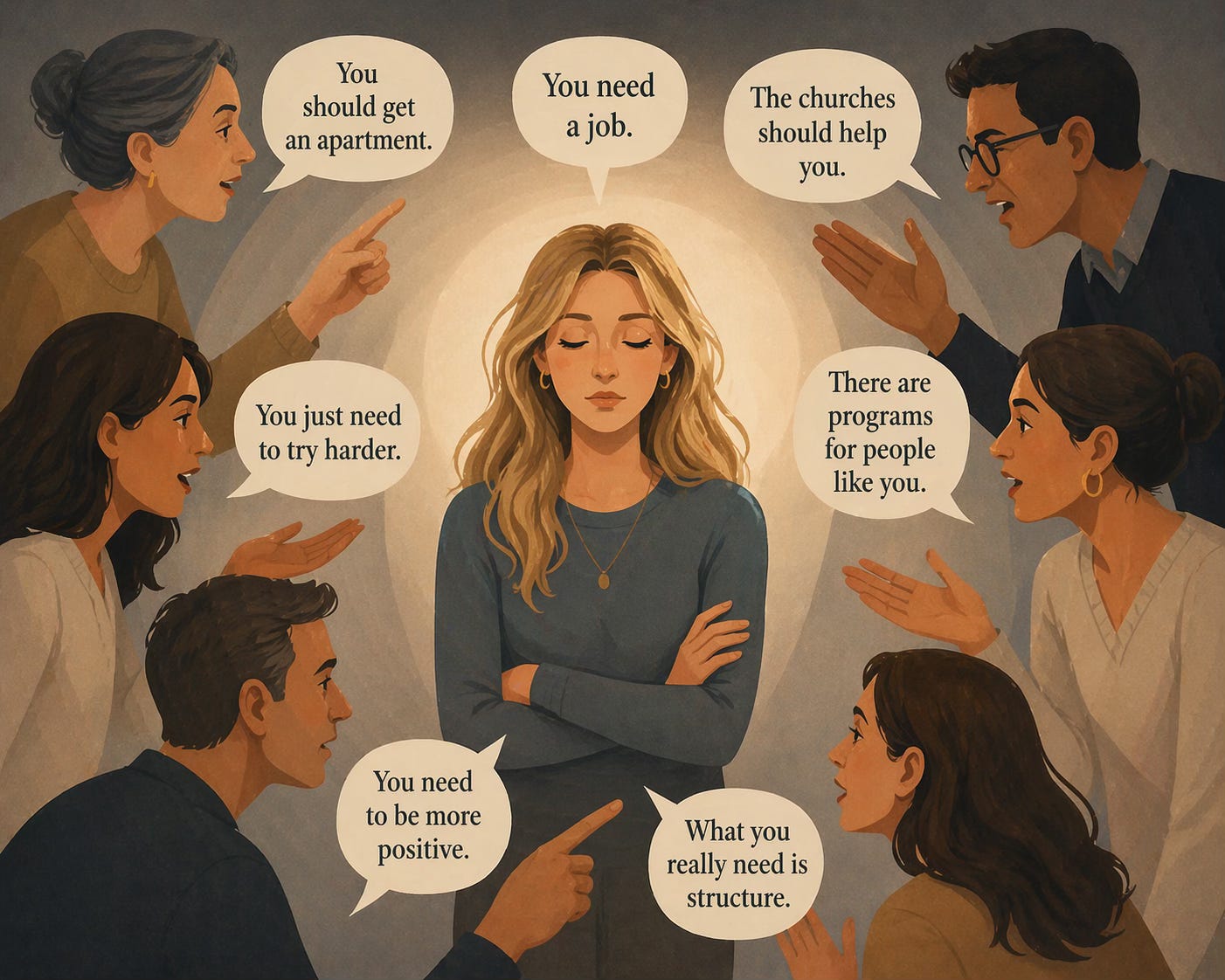
We struggle to imagine that someone could be content in a life that we would find unacceptable. We assume our version of safety, stability, and success is universal. But what if it isn’t? What if the cultural blueprint we’ve inherited—the house, job, routine, upward trajectory—isn’t the only path to a meaningful life? What if some people simply don’t want it?
We can check on others. We can offer help. But once that help is clearly and repeatedly declined, something shifts when we continue to insist. It stops being compassion, and it becomes control. It’s the worst sort of disingenuous dogooderism.
In the thread, a few people began speculating that the woman must be mentally ill. That’s often where we go when someone lives outside the boundaries of convention and refuses offers of a more conventional lifestyle. If we can label it pathology, we don’t have to question our assumptions.
Maybe she is mentally ill. Maybe she isn’t. I don’t know. I do know we are often too quick to pathologize difference. We mistake nonconformity for dysfunction because flouting or rejecting convention makes us uncomfortable. Discomfort has a way of disguising itself as concern.
This is where Ram Dass offers something that can feel almost counterintuitive: he says we have no moral right to take away another person’s suffering. Not because suffering is good or that we shouldn’t care. Quite the contrary. Suffering, like joy and sorrow, loss and love, is part of a person’s path. To interfere without invitation, or worse, to press a “solution” on someone by force, is to assume we know better than their conscience, life, timing, or inner work, which we, in fact, know nothing about. It’s a form of spiritual fascism.
Ram Dass isn’t telling us to turn away. Actually, he is asking us to look suffering in the eye and to be present without imposing, to offer without attachment, and to respect the autonomy of another soul, even when it makes us uncomfortable. Can you do that? I have, and it’s hard.
The real work is on ourselves, so we can “be there when the person comes up for air.” That’s not the same as trying to drag someone to the surface.
What If This Is You?
Before we go any further, it’s worth asking a harder question: What if this is you? It’s certainly me. I catch myself doing it, though less so these days. Quietly deciding what would be best for someone else. Not out loud, not always with action, but in that subtle internal way: If I were her, I would… or What she really needs is…
We all do it to one degree or another. It’s why people who have never been married feel comfortable dispensing marriage advice. It’s why people who have never had children have strong opinions about how to raise littles and are eager to share them with young mothers, unsolicited.
It’s why we look at someone else’s life and instinctively begin rearranging it in our minds. We mistake imagination for understanding.
So what do we do when we catch ourselves about to “should upon” someone? Maybe the first step is simply to pause and notice the impulse. Don’t judge or shame it, just see it for what it is: an attempt to make someone else’s life make sense to us.
Then, instead of offering a solution, we can ask a question. What do you need?
And then, and this is the hard part, we listen. If the answer doesn’t match what we expected, if they say something small, or something that feels insufficient, or at odds with our beliefs about what is good and nice, nothing at all…we acknowledge and respect it.
Real compassion is about being in relationship with the world. Sometimes the most helpful thing we can offer is not advice, but presence. There are other times when the most respectful and kindest thing we can do…is nothing but send love, to be peaceful.
What This Has to Do With Grief
If you’ve ever experienced deep grief, you already know this. You know what it feels like to have people tell you what you need.
You should get out more.
You should have a drink
You shouldn’t have a drink.
You should stay busy.
You should go to therapy.
You should visit the site “where it happened.”
You should talk to the driver of the car.
You should be grateful for what you still have.
You should be further along by now.
You should make your husband go out.
You should do things that will make you different from who you are right now, because who you are right now makes me uncomfortable.
Lots of shoulds…
I have heard it all. I respond as I did when I got child-rearing advice from childless people: smile and nod, and do whatever I wanted. Oh sure, I’d run the advice through my heart and mind, and if it seemed useful, I’d consider it, and if not, I’d move on. It was advice offered with the best of intentions, but it usually missed the mark. People who haven’t lost a child can’t imagine it and haven’t thought much about it (why would they? It’s an awful thing to think about). Grief doesn’t follow a script, and it certainly doesn’t respond well to someone else’s timeline.
What grieving people need, more often than not, is not direction. It’s permission. Just like the lady in the Jeep. Permission to feel what they feel. Freedom to move at their own pace. Liberation from being “fixed.”
Which is why this instinct, to decide what others need, is worth examining. It can come from a good place, or not. It always partly comes from the same discomfort with and desire to resolve what we cannot tolerate witnessing. The same quiet assumption: If I can fix this, I won’t have to look at it or feel it.
Perhaps the most challenging question of all is this: What if she isn’t suffering? Or at least, not in the way we think she is? What if the suffering we’re trying to fix belongs to us?
Wonderful. You really challenge the reader here, in the best way possible. We all are still learning I think…
Great post! You’ve given me a lot to consider.
My wife and I have dealt with the death of our son in our own ways. I believe that the secret to our success is that we recognize and respect the different ways that we are managing and healing.
On a slightly unrelated note, what do you make of a person who acts in a manner that takes them further from their explicitly stated goals? I see this pattern from my mother who says she wants one thing (she wants to spend time with a particular friend) and then will not consider suggestions to make that goal happen (give her a call or send her a message). I’ve stopped offering these suggestions and have come to realize that some people are more content having easily solved issues and not doing anything about them.