
What's Wrong With Right Here?
Why so many of us keep moving instead of facing ourselves

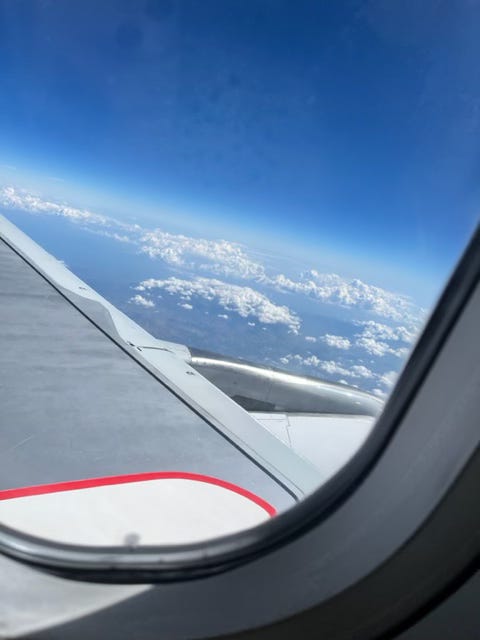
My photo from the plane window on our last trip together, which was to Greece, two weeks before Bix died, September 2022.
My cousin and her husband, whom I love very much, are constantly traveling. Every week, it seems, they are somewhere else. Puerto Rico. African Safari. Iceland. Mexico. Caribbean cruise. A weekend getaway. The social media postings are tiresome, and I don’t even acknowledge them anymore. Was I envious? She’s told me people are jealous of her travels. They accuse her of being rich. Was I that person, too? When I sat with the question, I understood that I was not envious at all. In fact, the thought of traveling that much makes me feel exhausted. I have no desire to take an African safari, for instance. I think many of them can be exploitative. And I find excess of any kind grotesque, especially advertisements on social media of a life that doesn’t exist. Can we enjoy something without showing it to everyone we know?
I also love my life at home: my house, neighborhood, routines, and friends. I love walking familiar streets, thrifting, acting, writing, cooking for people, sitting outside at dusk, and talking to Bix. I do not feel trapped by rootedness. I feel nourished by it.
Still, something about my cousin’s constant movement bothered me enough that I mentioned it to my husband one night, and he admitted he had noticed it too. They never seem to stop. Then I realized something uncomfortable. My cousin often tells me I think too much. She becomes visibly anxious around introspective people, including me. Intellectualism is her trigger. Thinking makes her nervous. My tendency to analyze, reflect, and question life probably disturbs her in the same way her perpetual motion exhausts me.
Suddenly, I understood that we may simply be mirrors for each other’s coping mechanisms. She escapes whatever she’s running from outwardly. I escape inward. Although that’s not really true either, since I am always moving, albeit in my home and community.
That realization softened me. It also made me wonder why so many of us struggle to simply stay where we are, both physically and emotionally. Why does stillness frighten us so much?
Ram Dass wrote often about this kind of searching. He was not against travel itself. He traveled extensively as a teacher and seeker, and understood the value of pilgrimage, discovery, and expansion. He also warned that external movement can become a spiritual distraction when it is used to avoid the present moment, and to avoid our psychic agony and perhaps our mortality (one fear I don’t have). He famously said that any trip you want to take leads to the same place. In other words, you bring your mind, your wounds, your fears, and your karma with you wherever you go. You can change scenery endlessly without ever truly changing yourself. You can jump off a mountain with a bungee cord, but you’re still right where you are until you deal with yourself. You are not “free” until you do that.

He often asked a deceptively simple question: “What is wrong with right here?”
That question unsettles me because I think many of us who have lost a child or other loved one already know the answer. Right here is where the grief lives. Right here is where the fear lives. Right here, loneliness, uncertainty, aging, regret, and mortality quietly wait. Constant movement can be a way to avoid hearing our own thoughts long enough for deeper truths to surface. You can't handle the truth!" said Colonel Nathan R. Jessup (Jack Nicholson) on the witness stand of A Few Good Men (1992). Maybe we think we can’t.
I was with my guide last week, and she told me she was preparing for something called a Vision Quest. She would spend four days alone in the desert with only water. No food, phone, books, journal, or music. No distractions of any kind. Just herself in a tent in the silence.
“What happens when you do that?” I asked her.
She smiled gently and said, “Eventually, you have to deal with yourself.”
The sentence landed in my body like a stone.
Eventually, you have to deal with yourself.
I remember feeling near panicked, imagining four days with no escape routes. No checking your phone. No chatting over dinner. No podcasts in your ears. No social media. No work. No errands. No travel itinerary. No selfies to post, smiling with a cocktail in hand. No ability to reach outside yourself every time discomfort rises. Just your own mind arriving fully, with nowhere left to go.
People who have lost children understand this terror intimately. Many grieving parents will tell you that being alone with your own thoughts after child loss can feel unbearable. The mind becomes a wilderness. It replays every memory, every regret, every alternate ending. Sometimes distraction is not shallow at all. Sometimes it is survival.
I also think our culture has become deeply uncomfortable with stillness in general. We are rewarded for busyness, movement, productivity, reinvention, and stimulation. We praise people for always being booked, traveling, hustling, or becoming someone new. Silence and solitude can be treated like personal failures.
Research in psychology actually supports what spiritual teachers like Ram Dass understood intuitively. There is now extensive research on what psychologists call experiential avoidance, the tendency to constantly avoid uncomfortable thoughts and emotions rather than process them. Studies show that while avoidance offers temporary relief, chronic avoidance often increases anxiety, emotional fragility, rumination, and inner restlessness over time. The emotions we refuse to face do not disappear. They wait for us.
Human beings have become remarkably sophisticated at distracting ourselves from ourselves. There have even been studies where participants preferred receiving mild electric shocks to sitting quietly alone with their thoughts for a short period. That fact is almost absurd until you realize how recognizable it is. Most of us instinctively reach for stimulation within moments of silence. We scroll, text, consume, eat, talk, listen. We move. Plan another trip. Go on another trip. Search for another reinvention of ourselves.
The problem is not travel itself. Travel can absolutely expand us. The problem begins when movement becomes avoidance. There is a profound difference between exploring the world and running from your own interior life.
I’m aware that thinking can become its own form of escape. Intellectualizing life is not necessarily more enlightened than physically outrunning it. Some people flee into motion. Others flee into analysis. Some people cannot sit still in a room, while others cannot stop narrating it once they sit down. I recognize myself in that, too.
Stillness is not necessarily meditation. You can “be still” with yourself without sitting cross-legged, trying to empty your mind. “Be still” can be taking a walk without headphones or sitting outside at dusk without reaching for the phone. Cooking a meal slowly or driving in silence. Remaining home for a weekend without trying to optimize every moment. Allowing, acknowledging, and embracing boredom, grief, fear, or uncertainty to rise without trying to anesthetize them.
What would happen if most of us attempted our own small Vision Quest, even for an hour?
No phone.
No television.
No noise.
No errands.
No consuming.
No performing.
Just ourselves.
What thoughts would finally catch up to us? What grief would surface? What truths have we postponed hearing? What if the reason we keep moving is that we already know?
The paradox is that the things we avoid often govern our lives from underneath anyway. When we never stay still long enough to hear ourselves, we risk spending an entire lifetime reacting without ever truly knowing who we are.
Another possibility is waiting on the other side of stillness. If we remain present long enough, something softer can emerge. We begin to notice beauty again. Seasons changing. The texture of ordinary life. Friendships deepening. The comfort of familiar streets. The sacredness of simple rituals. We stop relating to our lives as problems to escape and begin inhabiting them more fully.
Perhaps true freedom is not found in outrunning ourselves. Perhaps it begins the moment we stop long enough to listen.
If you are brave enough to experiment with stillness, I do not mean you need to meditate for an hour, sit cross-legged on a cushion, or achieve spiritual enlightenment. In fact, I think many people avoid stillness because they imagine it has to look profound or physically uncomfortable (I don’t know about you, but at 67, I just cannot sit on my legs for more than maybe 15 minutes tops). It does not.
Stillness can begin quietly. Leave your phone inside and sit on the porch for twenty minutes at dusk. Drive somewhere without music or podcasts filling every second of silence. Take a walk without photographing it, tracking it, or turning it into content. Cook a meal slowly without television in the background. Don’t photograph the result and post it on Instagram. Sit in your backyard and simply notice what thoughts arise when nothing is distracting you from yourself.
You do not have to force insight. You do not have to “do” anything correctly. The point is learning how quickly we reach for escape and gently resisting the urge every single time.
At first, you may feel restless. You may feel bored, lonely, sad, anxious, or irritated. That does not mean you are failing. It probably means you are finally hearing yourself beneath all the noise.
If grief rises, let it rise. If fear rises, let it rise. If joy rises unexpectedly, let that rise too. You are not trying to control your inner life. You are simply allowing yourself to witness it instead of constantly outrunning it.
You may discover that your mind is much louder than you realized. You may also discover that beneath all the noise is something surprisingly tender waiting for your attention.
The modern world trains us to believe that every uncomfortable feeling must be fixed immediately, distracted away, optimized, medicated, booked over, or scrolled past. But many emotions lose some of their power once we are willing to sit beside them without fleeing.
You do not need a four-day Vision Quest in the desert to begin. Most of us can barely tolerate ten quiet minutes without reaching for stimulation. Perhaps that is exactly why it matters.
Start where you are. Right here, right now.
Because the life you keep trying to get away from may be the very life asking to finally be lived.
Karen, this carries unusual depth because you did not reduce stillness to productivity, spirituality, or romantic escape. You held the harder truth that movement can sometimes be exploration, but it can also become avoidance. The question, “What’s wrong with right here?” runs deeply through the piece because it touches grief, loneliness, mortality, and the emotional weight many people keep outrunning in quieter ways.
Your honesty about escape taking different forms also gives this real balance. Naming travel, distraction, and stimulation alongside analysis and intellectualizing prevents the reflection from becoming about other people’s coping while leaving your own untouched. The invitation toward small acts of stillness, familiar streets, dusk, silence, and ordinary rituals feels especially grounded because it frames presence as practice, not performance.
Thank you for writing with such reflection about grief, avoidance, and the courage it can take to remain present long enough to hear what life may already be trying to say.
Love your insight on stillness. It’s one time to be honest with yourself. But so hard to do.