
Secular Humanism: Just Another "Ism"
Don’t let another bigot take away the mystery and the knowing


I’m fortunate to live near the beach, where the universe speaks clearly.
A lament I often see in grief groups is parents asking if their children are still “here” in some form. Where are they? Are they with me? Where did they go? Heartbreaking. I have asked these questions myself. I still ask them, even though I have some answers. These are questions that transcend time and space, history and science, knowing and unknowing. And yet there is always someone in these groups, sometimes more than one, who is compelled to display their pain in a hurtful way: “I don’t believe in God. Your child is dead. Your child is gone. God does not exist. The all-powerful universe in your mind is a fairy tale, except for what scientists know about it from space travel and telescopic observation.”
These statements are as hurtful and alarming as when someone imposes unsolicited specific religious beliefs on a grieving person. Maybe more so. They invalidate personal pain by forcing a specific worldview that dismisses the unique way a person processes loss. A directive like “there is no God” can make the grieving person feel alienated and isolated just as religious proclamations can. Nonbelievers can impose an emotional burden by forcing a vulnerable person to defend their worldview in a crisis just as fiercely as an enthusiastic believer can. Finally, such statements disrupt safe spaces like grief groups, which only work when participants feel safe, heard, and free from judgment or mandates.
If you don’t believe me, go inside a child-loss grief group and spend a little time there.
Other things I’ve heard: “I stopped believing in God when my child died.” “There’s no such thing as a higher power.” “There’s no old man with a white beard pulling the strings from a cloud.” “My church traumatized me, and I got out as soon as I could when I learned from insert-name-of-hand-picked-scientist-here that God is just a man-made story.”
Ah-ha. This admission reveals a profound, hidden truth about how beliefs are formed. While many non-believers claim their worldview is built on cold, hard logic, the reality is that for many, atheism is a coping mechanism for childhood trauma, a shield against religious abuse, and a psychological bid for absolute safety from it.
Data consistently shows that a massive percentage of people who leave religion do so because of Religious Trauma Syndrome or direct emotional abuse suffered within a church community. It results in confusion between a personal relationship with Source, God, Gaia, the Universe, call it/him/her whatever makes you happy (spirituality), and Big R Religion.
When we look closely at the loudest voices shouting that “dead is the end,” we begin to see that “logic” is often just a shield hiding an unhealed wound. Take Madalyn Murray O'Hair, arguably the most famous and aggressive atheist in American history. She didn't arrive at her militant stance through a quiet, neutral study of astrophysics. O’Hair’s fury was deeply personal, rooted in rejection by a man who refused to marry her and validate their child because of the rigid religious doctrines of the Catholic Church. Her life became a crusade to tear down the system she felt had wounded her. Madalyn would overturn bingo tables in church halls; her tantrums made public for all to see. She would berate any debater on TV. Imagine if social media existed when he was alive. But really, a cowardly man used the Catholic Church as cover for his infidelity and then abandonment of her and their child. O’Hair insisted on holding the blameless accountable.
As the trauma-sufferer develops, declaring “God doesn’t exist” might be the only way their psyche can find safety. It is an act of self-defense. If there is no God, then the abusive system that terrorized them loses its power. Their aggressive stance against your belief isn’t actually an argument about the universe; it could be a manifestation of unhealed childhood trauma. When they see you trusting in a loving Creator, which is not a spiritual bypass, it triggers their unresolved pain, and they lash out to protect themselves from the “monster” they believe religion to be, which doesn’t have much to do with what is going on in the Universe or the spirit, of course.
The idea of a supreme Source or a “Creator God” implies a vast, untamable wildness in the universe that cannot be controlled or predicted by human mathematics. To a specific psychological personality type, that lack of control is terrifying.
Believing that humans are the highest order of intelligence allows the scientific ego to feel completely secure. If we are the ones who will eventually explain everything, then we are in control of the universe. It turns the human mind into the ultimate anchor, protecting them from the existential vulnerability of a cosmos they cannot master.
Where is the evidence, the data, that secularism, secular humanism, and atheism have made the world a better place? Yes, many wars are fought over religion, but I also know this is often a human pretext, just like Madelyn Murray O’Hair’s officer lover did. One of the ugliest genocidal wars going on right now in real time is based on a secular political ideology couched as representative of an ancient religion. It isn’t.
There is a specific kind of person who reacts to the vast, terrifying mysteries of existence by adopting a patronizing intellectual pose. You’ve probably met them online, at dinner parties, or lurking in the comments sections of grief forums and right here on Substack. They aren’t actual scientists (guffaw!) or deep philosophers (chortle). They are proud secularists or casual atheists who practice scientism (another ism) or rationalism (yup) and carry an absolute, unshakable faith that human logic will eventually explain everything. To them, the human soul is just a silly, illogical puzzle we haven’t solved yet, and consciousness is a chemical algorithm waiting to be mapped out. They view the entire cosmos as a math problem that mankind will inevitably master given enough time.
It is a mindset that prides itself on being “smart” and “superior” (as every other ism tends to do), but when you lose a child, its fundamental bankruptcy is exposed. An atheist I know who has lost a son is angry and triggered by any talk of God or the source of the universe, specifically because of the stated experience he had in a church when he was a child. Indeed, he does everything in his power to prevent God from being discussed in public forums. If he’s secure in his knowledge, why the vitriol? Why is he threatened? Doesn’t he know that church doctrines are manmade (unlike the Truth, which is cosmic and hasn’t changed for millions of years), just as the scientific method is manmade? And therefore fallible?
Getting back to those in grief groups confronted with the anger and suffering of people traumatized by organized religion. Grief doesn’t live in some hypothetical future tense where science finally has all the answers. When your world fractures into a million pieces, the casual arrogance of people who treat your agony as a biological math problem isn’t just annoying. It can feel like a cold brush-off from a worldview that is, at its core, just another rigid, unfeeling, and bigoted “ism” like racism, sexism, and nationalism. Isms are based on the idea that a certain group (in this case, humans) holds systemic power, sets cultural rules, and is viewed as the “standard” for what is normal, good, or rational. In the humanists’ view, “mankind” is the top of the food chain.
We are told by modern culture that Humanism is a philosophy of ultimate compassion, a celebration of human reason, and a liberation from the dogmatic, fearful superstitions of old. We are told it is a safe, rational place to land.
But when humanism collides with the catastrophic loss of a child, its mask slips. You quickly realize that humanism isn’t always an objective window into reality. Like any other “ism,” it carries its own rigid dogmas, intellectual bigotry, and the capacity to inflict profound suffering on those already drowning.
Humanism explicitly crowns the human mind and its favorite tool, the scientific method, as the ultimate judge of what is real. It demands empirical, testable, and replicable data before it will allow you to believe anything.
But grief does not live in a laboratory. And scientists make mistakes. All the time. Stephen Hawking’s most notable scientific errors and oversimplifications include the Black Hole Information Paradox, his description of Hawking Radiation, and his Primordial Black Hole Dark Matter hypothesis. Einstein was wrong about a static universe, quantum entanglement, black holes, and gravitational waves. Linus Pauling, Charles Darwin (one of the gods of secular humanists), Fred Hoyle, and Thomas Edison also made big mistakes and miscalculations. I can go on, but I won’t.
Looking at a weeping mother or father and handing them a textbook on evolutionary biology isn’t rational; it’s inhumane. Just as it is life-wise cruel to tell a grieving mother her question about where her child is unserious and illogical. It prioritizes the abstract, man-made rules of an intellectually fallible system over the immediate, visceral reality of love and pain. It turns “science” into a dogmatic church and its proponents into a new priesthood that polices how we are allowed to feel if we’re truly intelligent and rational.
Why does someone in deep, suffocating grief need to care about this? Why should a grieving parent even bother analyzing the philosophical flaws in an “ism”?
They shouldn’t have to. The only reason it matters is that this rigid, “smart” mindset dominates our modern culture, acting like an invisible electric fence that shocks us when we try to heal. It penetrates into grief groups, as I noted at the top of this piece.
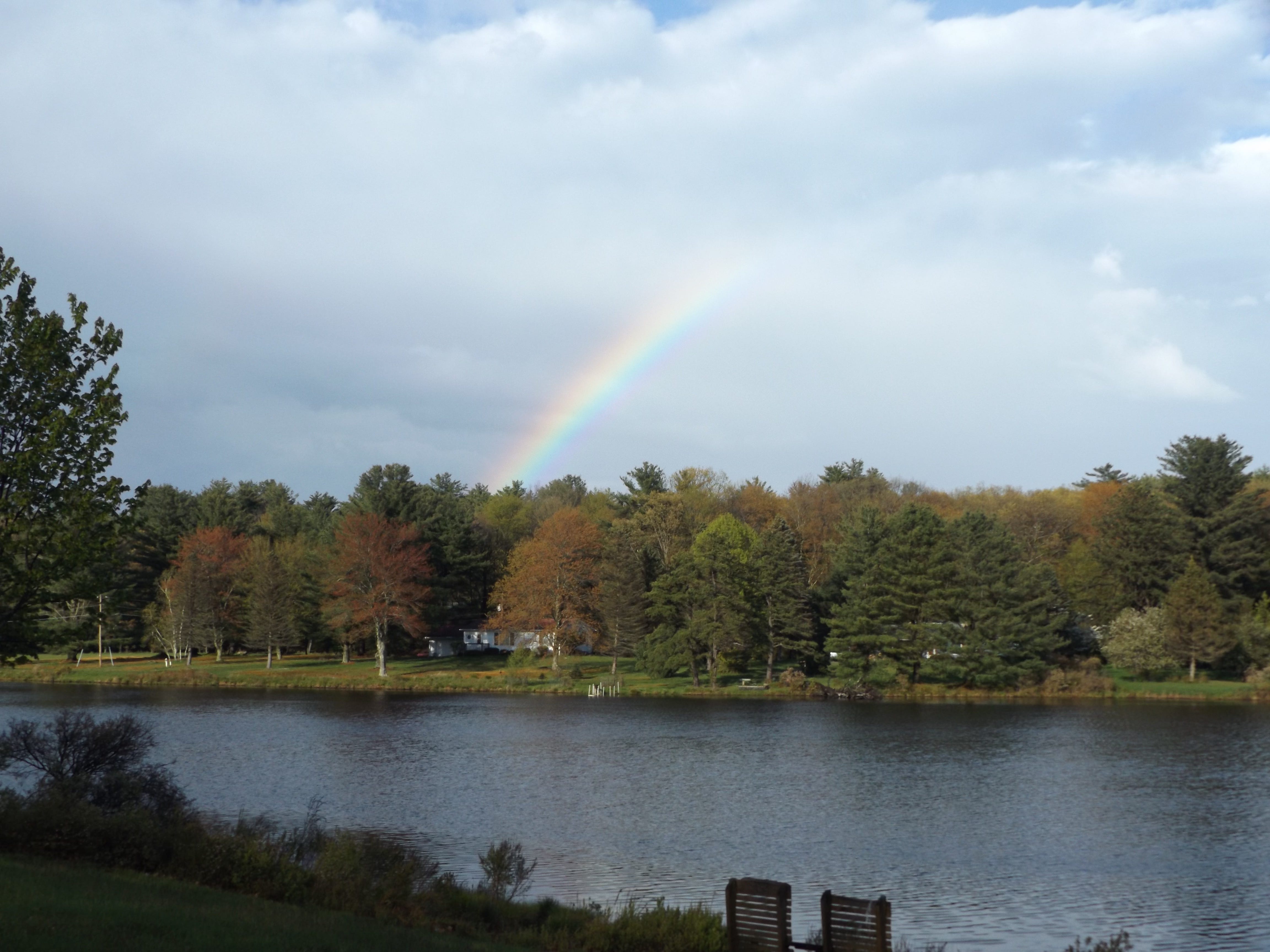
A rainbow in front of our old lakehouse.
When you lose a child, the belief that they still exist in some form isn’t an intellectual hobby or a philosophical debate. It is our oxygen. It is the thin thread that keeps us attached to sanity and survival. It may also be Truth. Our souls are healing a catastrophic wound by maintaining a connection to our child across the veil.
When someone barges into that fragile, sacred space and aggressively insists that “dead is the end,” they aren’t merely sharing an opinion. To a grieving parent’s psyche, that statement feels like a violent attempt to rip away the oxygen tank, a second execution of our child. That is not a person living “their best life” despite claims to the contrary.
Skeptics have told me I am just comforting myself. It’s a good thing I don’t feel the need to make them feel better. But I admit it. I am open to the mystery, but I also know I may be confirming my own biases—just as atheists confirm theirs when they pick and choose their experts.
I have had many cosmic experiences that help me understand that humans are a minor player in the universe. But if we are all just guessing, if we are all just choosing a bias to help us cope with the vast unknowability of death, then I am going to choose the bias toward love and mystery. More will be revealed.
The secular mindset is biased toward finality, materialism, and the “dead is the end” view because it is terrified of being tricked. It seeks control, predictability, and the safety of a laboratory. This bias protects the ego from being wrong. I am comfortable living in the mystery but also knowing we’re not the be-all and end-all of what’s going on in the cosmos. Have you seen us lately? We can’t possibly be the best thing going in the cosmos.
My bias protects my heart, honors my child, and keeps a sacred bond alive. It allows me to access things in the universe that are hidden from nonbelievers. I choose the bias that lets me talk to my child and hear from him. I choose the bias that keeps me breathing. My colleague’s bias leads to a cold, empty room. My bias leads me back to my child.
Bix and I continue our relationship. It has deepened since he left the earth plane.
To the rigid humanist, talking to a child who has passed away is dismissed as a delusion, a weak coping mechanism, or a refusal to accept reality. But love doesn’t obey the laws of thermodynamics. No wonder the atheists I know who have lost spouses and children are so openly lonely and angry. I have compassion for them because I understand how painful that emptiness is.
Why must we demand a receipt from the universe before we allow ourselves to extend our love into the unseen? We don’t.
When we give up the bigotry of needing to be “scientifically correct” about our grief, a vast, softer, and more compassionate landscape opens up. We admit that human beings and the tools we have invented over the last few centuries don’t come close to representing the absolute boundary of the cosmic plane.
The spiritual teacher Ram Dass used to say that we must polish the mirror of our minds, free of anger, to truly see. When we encounter people locked in the aggressive stance of nonexistence, we don’t have to fight them on their terms. We can recognize that they are simply blind to the light of the soul, desperately clinging to a tiny, man-made box because the mystery terrifies them. We don’t have to let a blind person describe the sunrise to us.
We can loosen our grip on their expectations. We can step out of the sterile laboratory of the mind and into the ancient, sacred rhythm of human intuition.
Talking to your child, feeling their presence, and staying fully open to the possibility that they have returned to a grander Source isn’t an escape from reality. It is the natural, healing extension of a bond that death cannot sever and that love makes infinite.
Humanism tells us to look into the mirror of the human mind for all our answers. But when you are grieving a child, that mirror is shattered. It is time to stop trying to fix the mirror, stop worshiping the “ism,” and simply look out into the beautiful, mysterious dark. And speak their name.
Remember, humans developed the scientific method. Which means it is imperfect. Love is not.
If you’re interested in a different take on grief and healing than you may see elsewhere, please consider subscribing. It’s free. Peace.
You bring up so many important points. Challenging a grieving persons beliefs is a type of bullying when you need comfort. Thanks for sharing.
First of all, thank you for writing this. I have so much to say to this, that I have been putting off commenting.
I am not a particularly religious person, and few things annoy me more than a person pushing their beliefs on me when I tell them to stop.
I have been friends with evangelical atheists that would not shut the fuck up about it. It got to the point where a friend of mine who was university physics professor with a PhD in physics said to me about a mutual friend of ours, "Rob puts too much faith in science." Rob was a firm disciple of Richard Dawkins and had a disdain for those who did not share his beliefs on science.
To contrast this, after Lucas died, I had another friend of mine send me a book that didn't really click with me. I made sure to read the entire thing and told her that it wasn't for me. After having short conversation about it and asking a few questions, she just sent me another book that was fantastic.
We just need to accept that other people deal with things differently from the way we might choose to and move on.