
Getting Older...and Wiser?
Clinging to how things used to be, and who we used to be is a cause of our own suffering...and others


There is a particular kind of suffering I started to notice after Bix died, and because I notice it, I assume it lives in me, too. It has to do with clinging. Not the dramatic kind we associate with grief, where we cling to the memory of the person we lost or the life we had with them, but something quieter and far more socially acceptable. It is clinging to a certain idea of relevance. It makes life difficult for everyone.
At 67, I find myself caught in an interesting cultural split. On one side, there is a steady stream of messaging suggesting that people my age are obsolete, out of touch, and somehow responsible for everything that has gone wrong in American culture. On the other side, there is an equally loud insistence that we can do anything! be anything! reinvent ourselves endlessly! and remain as vital and visible as we were at 45. Both are unhelpful distortions. I am interested in something else entirely: how relevance itself changes, and what happens when we refuse to let it.
I found myself thinking about this idea while rehearsing and performing my role as Miss Bates in Emma at the Venice Theatre.
Memorizing lines, building a character, rehearsing night after night, and stepping onto a stage is a love I discovered fairly recently, in 2018. Community theater has given me creativity, friendship, and a sense of belonging in my middle age. I was never a theater kid, but that’s a story for another day, so acting was all new to me.
I am also realistic. There may come a time when I cannot memorize lines anymore. It could happen tomorrow. It could happen years from now. Or perhaps it will never happen at all.
None of us knows. I have seen other older actors struggle with lines, and some are clinging, clinging, clinging to how they think things ought to be, the primary cause of human suffering. They insist on accommodations so they can be on stage. I don’t want to be that person.
When the day comes when I cannot remember lines or perform them well, my role in the theater will change. I pray I am self-aware enough to know it’s time to call it quits on acting and contribute in other ways. There are many ways to remain part of the life of a theater without standing under the lights. I might help with costumes. Assist with directing. Read scripts (or write them), or mentor younger actors. Or, I might do none of those things if doing them is for my ego and not in service of the theater. Perhaps I can enjoy my colleagues’ accomplishments as an audience member. I don’t want anyone to feel the need to bolster my ego’s need for relevance because doing so can cause pain for others, as I wrote about here.
Clinging to a specific self-image makes us rigid, which can lead to “crazy-making” situations in which others may feel misunderstood, criticized, or treated as mere avatars of our past issues. It creates “static” in communication, replacing open, two-way dialogue with a filter that distorts our words.
There is a man I serve with on a committee who is around 80 years old. He has done an enormous amount for the organization over the years, and that contribution is real. It is why he is still there. It is also why no one quite knows what to do with him. They have tried to move him out gracefully by honoring him, naming a room after him, retiring him from the board, and then, somehow, putting him back on the board. Each attempt at transition gets undone. Nothing loosens the grip. No one knows how to or has the guts to cut the cord. Everyone just waits for the inevitable, which serves no one, least of all the theater.
The truth, which people do not say out loud, is that his attachment to how things ought to be can make things difficult for other people. He dominates conversations, dismisses those whom he thinks are less intelligent, especially women, insists on being right and on having his way, and speaks in ways that leave little room for disagreement. It is easy to tell a story about his personality, but that explanation feels incomplete. What I am seeing is something deeper. It is his clinging, not just to a role, but to a definition of his relevance that no longer fits. I know many will come for me for saying this. But it’s true. When we cling to our ideas of who we were or who we wanted to be, we move through the world in destructive ways. I get it when Oprah told the BBC that, “…there’s a whole generation — I said this for apartheid South Africa, I said this for my own community in the South — there are still generations of people, older people, who were born and bred and marinated in it, in that prejudice and racism, and they just have to die” [for racism to disappear].
Ram Dass spoke about the stages of life, drawing on the Hindu model of the four ashramas. Whether you take that framework literally or not, it offers a useful map. In the first stage, we are students, learning how the world works. In the second, we become householders, building careers, raising families, contributing, and achieving. This is where most of America’s cultural definition of relevance resides. Just because it lives there doesn’t mean it’s true. We are relevant, the culture says, because we are doing, producing, leading, acquiring, and using power, and being seen.
But there are later stages, and this is where things begin to shift. The third stage is a gradual turning inward, a loosening of the grip on identity as something we perform. It is, as Ram Dass says, working on your own emptiness. The fourth goes even further. It is about renunciation, not in the sense of giving everything away, but in releasing the need to be defined at all.
This is where relevance gets redefined. Identity is a prison we decorate. We build it carefully over decades, layering on roles, accomplishments, opinions, and ways of being that seemed to make sense. Then, at a certain point, the next door of life opens, instead of walking out, we grip the walls and insist on staying in the same room. Not because it still fits, but because we no longer know who we are without it.
In the earlier stages of life, relevance is tied to output. What do you do? What have you built? How are you contributing in visible, measurable ways? In the later stages, relevance becomes something else entirely. It is no longer about doing more but about being. The elder who has made this shift does not need to assert importance, pontificate on politics, or tell people what they should know or think. Their presence carries something quieter: perspective, steadiness, and a lack of urgency around ego. They do not dominate a room. They change it simply by how they inhabit it. Silence is not about keeping your mouth shut, but about amplifying your soul. That kind of relevance is nearly invisible in our culture.
When the shift does not occur, the person remains organized around the earlier definition. They continue to try to do, control, and influence in the same ways they once did, but without the same structure supporting them. The roles are fading, but the identity remains. This is where the friction begins, not because they are old, but because they are clinging to a version of relevance that no longer applies.
There is another way to age into this, and I have seen it up close. My friend Dick Hyman is 99 years old as of March 8, 2026. A virtuoso pianist, a master of his craft, someone who spent a lifetime making music at the highest level. By any external measure, he has already been more than relevant, perhaps essential. Yet when you are with him now, that is not what you feel. You do not feel someone trying to hold onto who he was. You do not feel someone asserting his place or reminding you of his accomplishments. There is no reaching, no tightening, no need to prove anything. He is simply there. That presence is extraordinary. Powerful.
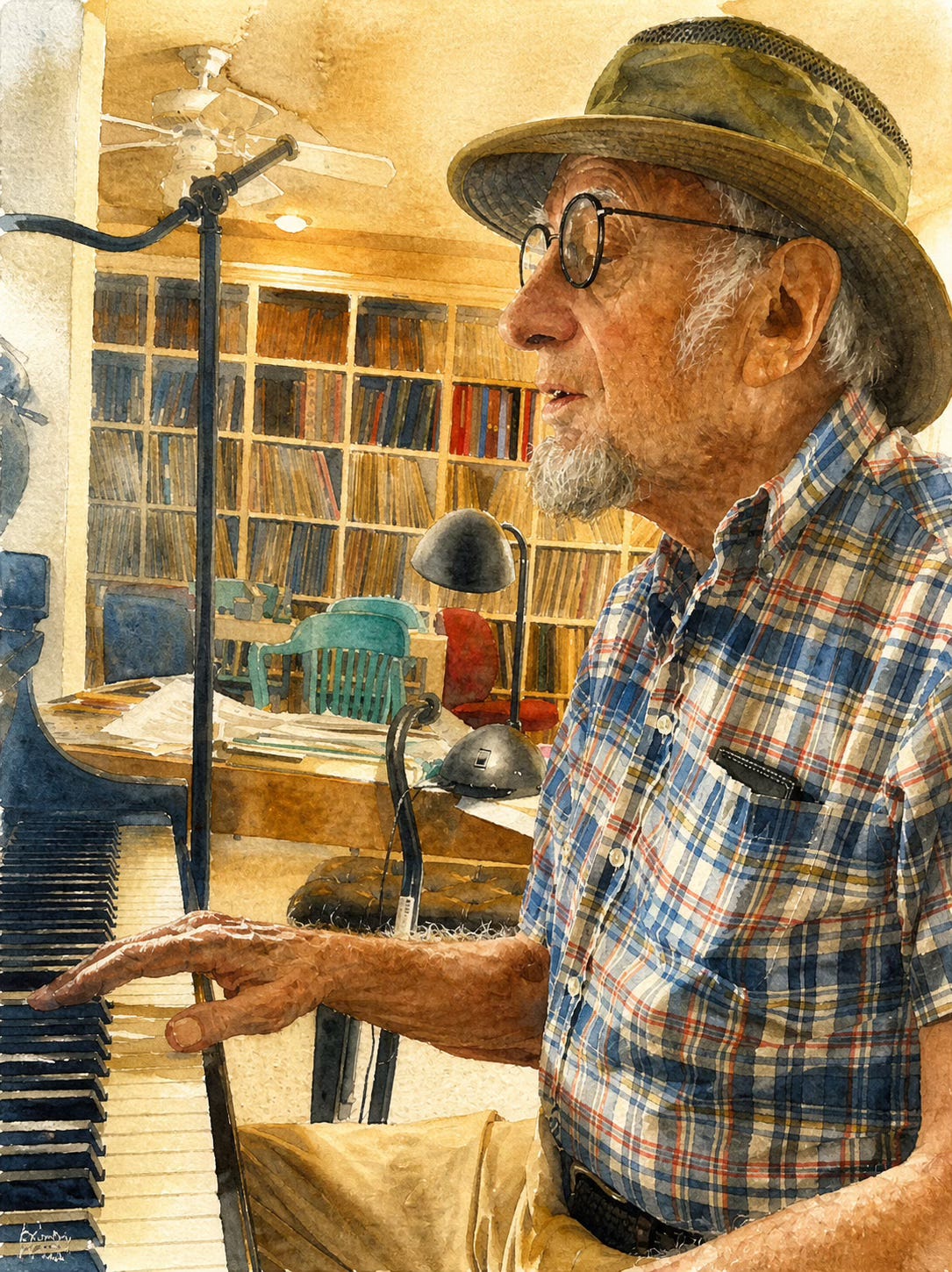
Watercolor rendition of my photo of Dick in his studio, October 2025.
It is light and love, grounded, and at ease. It carries a quiet joy. You are not being managed, instructed, or impressed. You are simply in the presence of someone who has nothing left to defend. He is not performing relevance. He is embodying something else entirely: beingness.
Being with Dick makes you understand that being is not a lesser form than doing. It is not what is left over after the real work is done. It is its own work, and in many ways, a higher one. To be fully present without needing to assert identity, to inhabit a moment without organizing it around yourself, and to allow life to move through you without constantly shaping it into who you think you are is not passive. It is refined, dynamic, even. Ironic, isn’t it? It is what Ram Dass was pointing to. Then another thought comes to mind, one that is harder but more honest.
What if the difference is not just about personality? What if it has to do with whether we ever felt relevant in the first place?
If your life has been an expression of something you loved that flowed through you, rather than something you had to force, as it has been for Dick, perhaps it is easier to let it go. There is less unfinished business, less need to prove, and less grasping for recognition that was never realized.
However, if you spent a lifetime doing what you thought you were supposed to do, without ever quite feeling seen or fulfilled, the need for relevance does not fade. It intensifies. And maybe that is part of the suffering, not just that relevance is changing, but that it never fully arrived as you needed it to. That does not excuse behavior that harms others, but it does invite a different kind of understanding.
Grief has a way of accelerating this transition, whether we want it to or not. When my son died, the entire framework of who I was in the world cracked open, not philosophically but viscerally. The roles did not disappear, but they lost their solidity. The idea that I could build a stable identity from doing, achieving, or being seen no longer made sense. Grief does not politely suggest that you let go. It removes what you thought you could not live without, and in that space, something else becomes visible.
When I sit in a room with someone still fighting to matter, I feel two things at once. I feel discomfort and recognition. I can see the same impulse in myself, the flicker that wonders whether I am still relevant, whether I still matter as I used to. That is the hook. That is the clinging.
The question is not whether we will age out of certain roles. We will. The question is whether we are willing to let relevance evolve with us, whether we can shift from being relevant because of what we do to being relevant because of who we are, and whether we can stop clinging to the doorway on the way out and trust that something quieter and more meaningful is waiting on the other side.
Then there is the practical question: what do we do when we are in a relationship with someone who cannot make that shift? Ram Dass offered a grounded answer. You are not required to feed another person’s ego, but you are invited to meet them with awareness. He described becoming a “loving rock.” The rock is the part of you that stays grounded and is not pulled into their drama, demands, or need to control. Loving is the part that recognizes what lies beneath: fear, disorientation, and a deep attachment to an identity slipping away. This is not passive. It requires boundaries.
Clear, dharmic boundaries are part of compassion. You can say, “I can stay for an hour, and then I need to leave,” or “I am not willing to continue this conversation if it continues this way.” Or, “I am not willing to agree with you on something I feel is wrong in my heart to soothe your ego.” This is what he meant by detaching with love. You take care of your nervous system so you do not become reactive; once you are reactive, you are no longer helping anyone.
It also helps to see the soul behind the role. When someone demands relevance, you can notice the pattern rather than arguing with it. You do not have to validate it or fight it. You can simply witness it. In doing so, you stop feeding the identity that is causing the suffering.
If there is suffering here, it is worth asking a different question. Not, “Am I still relevant?” but rather, “What version of relevance am I clinging to?”
You can usually feel the answer. It shows up as tightening, urgency, and the need to be right, to be heard, to be included, and to be seen in a particular way. It also shows up as irritation when others do not defer or when the room no longer organizes itself around you as it once did. It can feel like being overlooked, but beneath that is often something more fragile: the sense that without that role, you might disappear. That is the moment to pay attention. What feels like a loss of relevance is often just a mismatch between who you were required to be and who life is now asking you to become.
Clinging rarely feels like clinging from the inside. It feels like righteousness, necessity, or even survival. It feels like “I still matter” or “This is who I am.” In many ways, you did matter. It was who you were. That identity carried you through an entire phase of life. Phases end. When they do, the work is not to hold them in place. The work is to let them loosen.
Start small. You notice where you are pushing when you could soften, where you are asserting when you could allow, and where you are speaking when you could listen. Experiment with not needing to be at the center of every decision. Try being in the room without feeling as if you have to organize it, or that it has to be organized around you. Allow silence without rushing to fill it with your expertise, opinion, or history.
None of this means you disappear. It doesn’t mean you can’t take singing lessons at 76, or go back to law school in your 60s or 80s, or that you can’t make contributions in practical and actionable ways until you die. It means we “do” from a different place. In our being, the doing becomes less about the acquisition of power and control, less about inserting “I count” into every social equation, and more about the dharma of giving with an open heart and without attachment to outcome. It involves giving freely without expecting reward. There’s nothing to “win.”
If you are on the other side of it, sitting across from someone who cannot let go, the practice is different yet related. You do not have to fight them or fix them. You can hold your boundaries and still meet them with steadiness. You can refuse the role they assign you without withdrawing your humanity. You can be present without participating in the struggle.
My final hope for myself is that when I am asked to leave a room, I do not insist on staying. This is my reflection on grace, self-awareness, and timing. Knowing when to exit, whether from a project, a role, a relationship, or a phase of life, is often more difficult than knowing when to enter. The desire to stay past one’s time usually stems from ego, fear of irrelevance, or a sense of security. Leaving with dignity allows for new beginnings and honors the work that came before. It is a quiet strength to accept that our time in a particular “room” has concluded.
The question underneath this essay is, What would it be like to stop needing to be somebody? Not as a loss. As a release.
It’s wonderful.
Thank you. I lost my son in November 2019. A few months later, we went into Covid lockdown. My consulting protects were put on hold. When the world restarted, I realized that I didn’t want to do that work anymore. Being recognized as “the expert,” and using my influence to improve organizations was my motivation and identity for over 30 years. And then it wasn’t. At first I searched for a new purpose, like all the articles on retirement told me I should. It was when I let go of those expectations that opportunities to contribute in a quieter way started to come my way. Now I’m comfortable in the background. Instead of running meetings for the nonprofit I volunteer with, I mentor younger leaders. I don’t crave the admiration of strangers, I just want to be present with and relevant to my family and friends.
Love this Karen: . To be fully present without needing to assert identity, to inhabit a moment without organizing it around yourself, and to allow life to move through you without constantly shaping it into who you think you are is not passive. It is refined, dynamic, even. Ironic, isn’t it? It is what Ram Dass was pointing to. Then another thought comes to mind, one that is harder but more honest.”