
100% Human, Whatever That Means
Don't Let Pangram Bully You Out of Speaking Your Truth

When I first lost Bix, I was lost. My brain fog was bad. I had just signed a lucrative contract with an uber-successful entrepreneur to write her memoir when he died. When I sign a contract, it is ironclad. My thirty-plus-year career is hinged on my reliability, consistency, and commitment. When I say I am going to do something, I do it—even though the death of a child could have been covered under the Act of God clause that is in every single book contract I have ever negotiated, which is way more than fifty, because I was an acquiring editor for years before I started writing books professionally in 1999. I could have backed out. I didn’t.
Back to brain fog. In the months (even these past 4 years) after Bix died, I would think I had returned calls or texts when I hadn’t. I didn’t answer every note I received after Bix died. I remember hearing a woman in a grief group I was in say, “Well, I’m from the South. We put on our big girl pants and write thank-you notes. That’s what I did.”
Now I’m supposed to feel humiliation and contrition because Southern women are superior to women from the Northeast? Thank you, grief group, for helping me understand.
I am from the Northeast. I went to finishing school. I write thank-you notes. My son died. I didn’t write thank-you notes to every one of the hundreds of people who sent letters and cards to me (and for the record, greeting cards of any kind do not require a formal acknowledgment of receipt). I lost checks for a nonprofit we asked people to donate to, not to us (but they sent them to us anyway) because my husband and I both had brain fog. I accept it.
I did go on to write that book. I was on my client’s yacht a month after Bix died, taking notes and interviewing her without saying one word about my son. It was weird, lying in my stateroom at night, looking out at the Palm Beach night sky. The ship was docked there because it’s one of the few deep-water docks in Florida that can accommodate what are called “super yachts.” I was so sad because Bix would have relished the fact that his mom was on a fancy ship. Writing has given me such amazing gifts and put me in extraordinary situations.
This was a case where I hadn’t written a proposal for the book, so I had no roadmap to follow. Frankly, I could have used some help organizing my thoughts. It took me almost 4 years to start writing Substack essays about my grief journey. Thinking is hard when you’re in grief. Fortunately, I have a strong writing practice since I have been a professional writer and editor since 1982. I overthink just about everything.
Still, there were days when I was in tears because I could not organize my thoughts from A to B, let alone from A to F back to C before getting to Z, which is often the case with memoirs. Anyone who says writing nonfiction isn’t “creative” has no business teaching writing to anyone, anytime, anywhere.
I finished that book over the course of a year, but turned down other projects for the next two years. About a year ago, I agreed to write a proposal for a new client, and that went on to find a publisher (as all of my proposals do; my track record is batting 1000). I recently wrote another proposal for a long-time client, and that resulted in a two-book deal with one of the big five houses. I fell back on old skills and pressed forward, but I won’t say it wasn’t exhausting, because it was.
My own book gets stuck because my brain doesn’t formulate complex ideas as it once did. Grief changes your brain; it changes us at the cellular level. If the time comes when I cannot for the life of me organize a thought, you better believe I will use AI. Fortunately, I have had the privilege of education and years of experience. I’ve been in publishing since 1982 and have been writing full-time since 1999. Plus, the universe, God, DNA (whatever triggers you the least), has bestowed a natural ability in me so I could overcome most of my brain blocks.
But I get it. That’s why AI detectors worry me. People who want to express themselves who don’t have the kind of experience I have, but are aching to say something important, may now be afraid to do so.
I want to talk to people in deep grief as well as marginalized people who may not have the tools or the privilege I had. To those for whom English is a second or third language. To neurodivergent people, who often write in a consistent, precise syntax that AI scanners consistently misidentify as machine-generated. I want you to speak your truth.
I want to encourage everyone to express themselves, even if you need help. Don’t let Substack bully you. I hope and pray potential readers can see through this mess, and don’t punish or ignore people from marginalized and trauma communities who want to express themselves just because their essays didn’t come back tested (by an AI program) as “100% human.”
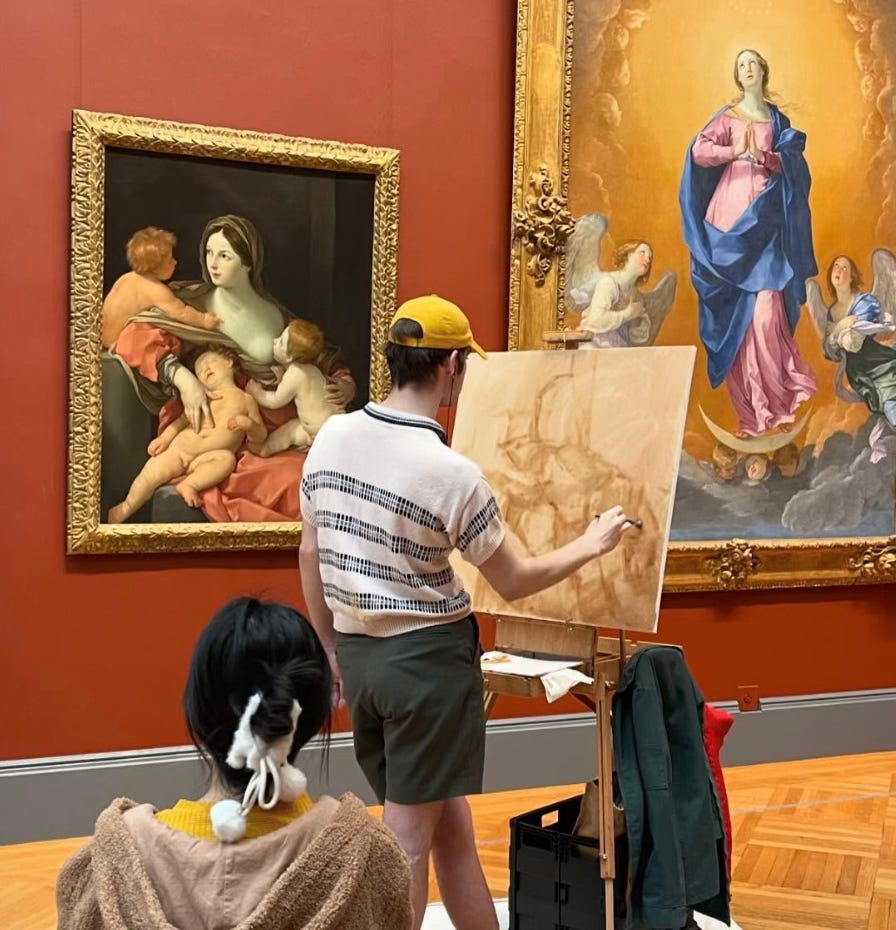
Are there any polite Southern belles out there who have been to the Metropolitan Museum of Art? If so, they have undoubtedly seen someone sitting in front of a masterwork, copying it. They are not forgers. They are not going to pass it off as the real thing. They are learning to paint, and to communicate through art. Emerging writers emulate styles too. When I was in college, we were tasked with writing in the style of Hemingway, Updike, and on and on—not to steal their style, but to learn, for God’s sake. The late journalist, literary critic, and writer William Zinsser said, in his classic book On Writing Well, that writing well is learned by imitation. Does anyone object to any of these modes of learning? What privileges them over other modes of learning? I’ll wait.
And what do you think I do for a living? I write books for and with other people, an accepted and respected profession in publishing. I know there are big fat snobs out there who think people should write their own books because I’ve met them. Good for you. I believe that writing a good letter is a skill everyone should have, but writing 75000 cohesive words is not a general skill that everyone should have. Some people need help, so they hire people like me to collaborate with them. Now people are collaborating with AI; people who cannot financially access people like me. I am glad for that if they have something important they need to get off their chests, or even if they don’t.
I listen to people and capture their distinct voice on the page. That’s what I am known for in the industry and one reason people hire me. It takes skill and creativity. Working on a nonfiction book is not like writing a college research paper. I’ve never had to sell an online book writing course, start a YouTube channel, or cultivate a social media following. I could remain a nobody because I’m good at what I do: capturing people’s voices and telling their stories in a narrative fashion (on deadline).
AI has a “voice” too, and that is what AI detectors identify (using AI). I can capture the AI voice and write something 100% by me that will come back in an AI test as 80-100% AI-generated. I’ll say it again: AI has a “voice” that is replicable by humans who are skilled enough to do so. That is to say, the AI program that tests for AI is imperfect. Machines make mistakes.
That’s something else to think about. We trust in AI to tell us about AI because we don’t like AI? Okay…
The worriers out there may have forgotten or didn’t know that AI exists because of humans, cannot currently exist without them, and everything AI knows is based on human output. AI also isn’t going anywhere, and if you use the internet, apps on your phone, or at-home devices like Alexa, you use AI. Technology is a funny thing; it improves and is replaced, but it never goes away. In 1945, the New York City elevator operators union went on strike to retaliate against the threat of self-service elevators. The strike hastened the technology it sought to stop. Sit with that for a minute.
I’m personally not worried about AI. It doesn’t threaten me or my job. I know it can help people. Like any tool, it can also be misused by humans. Humans…we just can’t control them to our liking!
I had the privilege of working with futurist and technology innovator Martine Rothblatt on a book called Virtually Human: The Promise—and the Peril—of Digital Immortality, published in September of 2014, by St. Martin's Press. It’s a book about AI and ahead of its time, like everything Martine does. So I feel fairly informed about AI. And I recommend the book. I’ve been paid for the work, so don’t think I’m linking to it for financial reasons. I’m linking to it because there are many people who would do well to educate themselves about AI.
That’s who I “worry” about. The people announcing on Substack and other formats that they are “so happy” that an AI program is getting “all the muck” off of Substack. Trust me, bro’ there is plenty of trash that’s 100% human-written all over the place, and protesting AI ain’t gonna get rid of it. People who feel this way are uninformed elitists, and they’re advertising it.
Not long ago, Martine said that “the real transformation won’t be in the technology. It’ll be in how we choose to use it. Will we let it deepen our empathy, expand our understanding, and preserve our legacy, or will we let it reinforce our biases, isolate us in echo chambers, and erase the very things that make us human? The dance isn’t about who leads. It’s about how we move together, with intention, with care, with a shared commitment to meaning. And in that movement, I believe we will discover not just smarter machines, but wiser humans.”
In the meantime, while we all work on getting wiser, AI can help people who haven’t been able to access a writing education for all the reasons I listed earlier. Their stuff may be the “slop” some arrogant fop is referring to when he proclaims with glee that an AI program is going to fix Substack’s AI problem.
Everyone should be able to speak their truth; it’s how we understand each other and realize we all are one, all different versions of the same source.
AI is one of many accessible tools people can use to communicate their stories. It can help them learn. People can read dozens of writing books and develop a daily writing practice. They can find a teacher (which costs money, so teachers aren't available to everyone). They can go back to school or take a night class or workshop. But they shouldn’t wait to publish their work if they have something to say, if AI can help them say it. And they don’t have to explain themselves, either.
The question is, can readers have compassion and look to a piece for its truth? Do we have any discernment at all? How tragic.
This is the first and last time I will make a statement about AI because it does have a connection to the grief community, as I’ve explained. Have a nice weekend.
Thank you for giving a perspective that I hadn't really thought of before: people using AI as a tool to help tell a story when they haven't developed the skill to tell it in a cohesive manner. I think that's a fantastic use of AI.
My issue is less with AI, but with the misuse and over reliance on technology in general.
As an educator, I see this issue from an educational standpoint. In order to acquire a skill there needs to be a low level of struggle, whether it be with writing or with math. More and more, I am seeing a much lower tolerance to that struggle as students give up and go to the tools, denying themselves the opportunity to develop the skills.
What I hear from people who are anti-AI is, "I put in the time to develop the skill and other people need to as well!" or in a more general sense, "Kids these days only want shortcuts!"
Your point of using AI to get stories out there that need to be told is well-taken. The problem for me is when we as society decide that is a suitable end point for everyone.
You’ve given hope to this late bloomer. I embarked on a historical fiction a few years ago. I’m on my 3rd iteration. I’ve used AI to check my grammar and correct tense, with each submission I’ve written prompts like, “please just check what I asked you to check. I do not want you to write my book. I just want you to check my grammar, unless you can’t resist, but I won’t use your prose.” I’ve been doing it for a year now. Recently, when I did that, AI came back and told me, “I laughed out loud. I’m really invested in your story. I like your style. It will take a lot of self-control not to want to write the novel for you. My self-control may be tested, if you write about alligators with sapphire eyes, or that man walking in the moonlit garden.” I was shocked. I felt like I had already been chosen by a publisher and was working with an editor (or how I imagine working with an editor would be like.)
And I totally agree with your assessment of the situation; it’s a great way for everyone to get help writing. Not everyone can afford $100 an hour for someone to read your writing.